Candy Ball Run - Rolling Games
- 3.5
- Rating
- 5.00M
- Installs
- Free
- Price

 Analysis by App-foxy
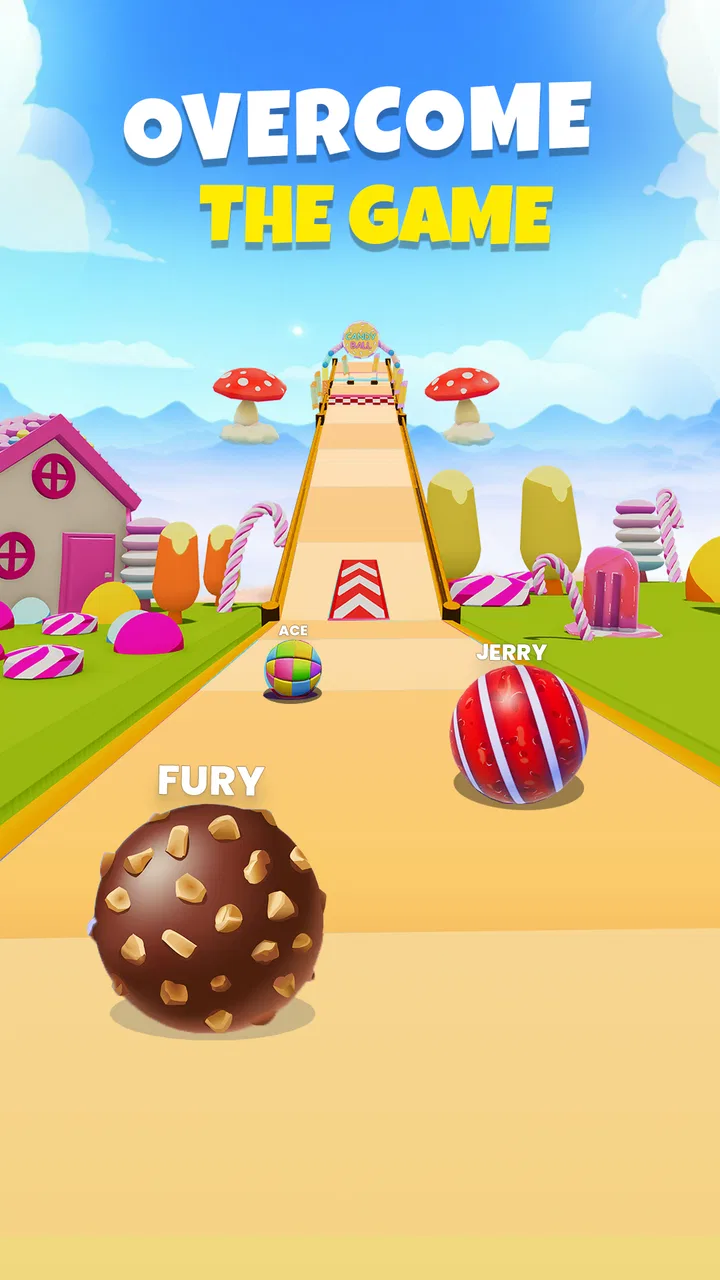
I approached Candy Ball Run - Rolling Games expecting a simple reflex game, and that is exactly where its appeal lies. You guide a rolling candy ball, avoid obstacles, and gather sweets while trying to keep the run going. It is a light role-playing game in presentation, but the moment-to-moment experience is much closer to a quick arcade challenge than to a story-heavy adventure. I found it easiest to enjoy in short sessions, when I wanted something immediately understandable rather than a game that needed a long explanation.
The basic idea is friendly enough for almost anyone to grasp. The ball keeps moving, the path presents hazards, and my attention has to stay on timing and positioning. There is no complicated opening tutorial to work through before the action becomes clear. That simplicity is useful on a phone because I can start a run quickly, understand what went wrong, and try again without spending several minutes rebuilding context.
At the same time, the modest rating of 3.6 from around 3,700 ratings tells me this is not a universally satisfying game. That feels fair. The candy theme makes it approachable, but the underlying loop depends heavily on whether I enjoy repeating short attempts and improving through practice. If I need a deep role-playing system, a substantial narrative, or a wide range of strategic choices, this is unlikely to become a favorite.
You May Also Like

 Blood Strike: 2.5 Anniversary
Blood Strike’s Loadouts Turn Every Drop Into a Tactical Gamble
A close look at Blood Strike’s custom loadouts: how fast access to signature weapons reshapes its battle royale rhythm, rewards preparation, and narrows the gap between fights.

 Pandora - Music & Podcasts
Pandora’s Music Is Easy to Start, but Harder to Recover
Pandora’s strength is its low-effort path from a seed to a station. Its weak spot is how much confidence it asks you to place in connection, setup, and quiet recovery.

 8 Ball Pool
 Is Built on Rivalries, Rematches, and Routine
A close look at the rivalries, rematches, shared routines, and unanswered safety questions that turn a quick pool match into a persistent mobile community.

 Samsung Music
’s Quiet Strength Is Playing What You Already Own
Its reach comes less from spectacle than from dependable access to a personal library. That simplicity is both the app’s strongest retention engine and its ceiling.

 AccuWeather: Weather Radar
AccuWeather Review: A Quick, Clear Forecast for Everyday Decisions
For everyday plans, the best forecast is the one you can understand quickly. AccuWeather makes rain timing, radar, and local conditions easy to act on, with a few trade-offs.

 Hill Climb Racing
Why Hill Climb Racing Still Turns Crashes Into One More Run
A tiny car, a bumpy hill and one more upgrade: Hill Climb Racing keeps resurfacing because its simple chaos makes every near-miss feel personal.
More From Our News Desk



How the run develops from the first tap
I find the first tap most useful as a chance to learn, not to chase a perfect run: I can watch how the ball responds, notice where a tempting candy pulls my attention, and decide what to change next time. That small reset between attempts gives the game its practical rhythm, and it also makes taking turns on a shared phone easy to explain.
Early goals that make the controls understandable
The first useful goal is simply staying alive long enough to read the route. Collecting candy gives each movement more purpose than merely dodging objects, while obstacles create the immediate reason to pay attention. I did not need a long-term plan at the beginning. My first few attempts were about learning how the ball responds, recognizing safe openings, and deciding when collecting something was worth the risk.
That last decision is more important than the cheerful theme suggests. A candy placed near danger is not automatically worth taking. When I focused too much on collecting everything, I made careless movements and ended runs that could have continued. A better approach was to treat candy as an opportunity rather than a command: take the easy pickups, but prioritize a clean path when the route becomes crowded.
This creates a useful early rhythm. I could make progress without knowing every detail, then adjust after each mistake. The game works best when I treat each attempt as a small lesson rather than expecting a perfect run immediately. Its straightforward design also makes it suitable for younger players, matching its Everyone content rating, although children may still need help understanding that collecting every candy is not always the smartest move.
What counts as progress during play
The clearest progress signal is the run itself. Staying on the path, passing obstacles, and collecting more candy all give me immediate evidence that my timing is improving. I found this more satisfying than a system that hides improvement behind menus. Even when I did not reach a personal best, surviving a section that had previously caused trouble felt meaningful.
There is a trade-off here. Because the central loop is so direct, the game’s sense of advancement depends on how much I value personal improvement. Players who want frequent unlocks, character development, equipment choices, or a clearly expanding campaign may find the progression less substantial than expected from the role-playing label. The experience is built around doing the run better, not around managing a large collection of systems.
My practical advice is to set small targets instead of chasing a flawless result. On one attempt, I might concentrate on avoiding unnecessary risks. On another, I might try to collect more candy while keeping the same level of control. This makes the game feel less repetitive because the objective changes according to my own focus, even when the basic actions remain familiar.
Why the difficulty feels personal rather than dramatic
The challenge comes from maintaining attention while the ball continues through the course. A mistake is usually easy to understand: I reacted late, moved toward a tempting pickup, or failed to leave enough room around an obstacle. That clarity is one of the game’s strengths. I rarely felt confused about why a run ended, which made restarting feel reasonable rather than frustrating.
However, this style of difficulty can become tiring if I am not in the mood for repetition. The game does not need a complex enemy system to demand concentration; the combination of movement, obstacles, and collection already does that. Short sessions are therefore more comfortable than long marathons. After several attempts, I found my decisions becoming rushed, and taking a break was more useful than forcing another run.
The pacing also suits casual phone play. I could use it while waiting for an appointment or during a brief break, because the core objective is immediate. It is less suitable for someone looking for a calm idle experience. Although the candy visuals are playful, the need to react and avoid hazards keeps the game active rather than relaxing.
Three ways to play more intelligently
My first useful technique was to watch the route ahead instead of staring only at the ball. Looking slightly forward gave me more time to choose a line, especially when a candy pickup tempted me to move at the last moment. This sounds obvious, but it changes the game from frantic reaction to early planning.
Second, I stopped treating the center of the path as automatically safe. A central position can be comfortable, but it may also leave fewer options when an obstacle appears. Staying flexible and making smaller adjustments helped me preserve room for the next decision. Large, hurried movements were usually more dangerous than controlled corrections.
Third, I separated collection practice from survival practice. When I wanted to understand the route, I focused on staying alive and ignored risky candy. Once the movement felt familiar, I attempted more ambitious collections. This two-stage approach made improvement easier to notice and reduced the feeling that every attempt had to achieve everything at once.
Where retention works and where it may feel like pressure
The game encourages another attempt naturally because the rules are simple and the reason for failure is visible. I often felt that one more run could be better, particularly after making a mistake near a section I had just learned. That is a healthy kind of replay motivation when I choose it for myself.
Still, players should be aware of the difference between genuine challenge and repetition without enough variety. If the main appeal of a game is discovering new mechanics, building a team, or unlocking a changing world, this rolling format may feel narrow. The store lists in-app purchases ranging from forty-nine cents to ninety-nine dollars and ninety-nine cents per item, so I would approach optional spending carefully and decide in advance whether the basic free experience already gives me enough enjoyment.
The game is free to start, which lowers the barrier for trying it. I would not recommend spending money immediately. First, I would play enough short sessions to decide whether the obstacle-dodging loop remains enjoyable after the novelty of the candy theme fades. For a casual player, the free entry is the main advantage; for a highly competitive player, spending will not replace the practice needed to improve timing.
Who will enjoy the structure most
I would recommend it to someone who likes compact arcade challenges, colorful themes, and games that can be understood in seconds. It is also a reasonable choice for families looking for an accessible title with an Everyone age rating. A child or new mobile player can understand the basic aim quickly, while an experienced player can still look for cleaner routes and better collection decisions.
A realistic everyday use case is a short commute or a few minutes before an appointment. I can launch the game, complete several attempts, and put the phone away without losing track of a complicated story or a large inventory. That makes it more convenient than many traditional role-playing games, which often ask for longer sessions and more attention to menus, quests, and character management.
I would skip it if my priority is a rich role-playing adventure. Compared with conventional games in that category, this one offers less emphasis on narrative choices, character builds, exploration, and long-form strategy. I would also look elsewhere if I dislike repeating a route after a failed attempt. A puzzle game may suit me better when I want deliberate thinking, while a deeper role-playing title is a better choice when I want progression that changes how my characters play.
Sharing a phone without sharing expectations
On a shared household device, I would treat this as a game for taking turns rather than assume each person has a separate space or personal progress. The immediate run-based format makes that practical: one player can try a route, pass the phone on, and explain a simple lesson such as avoiding a risky pickup. If several people use the same device, agreeing whose turn it is matters more than coordinating a team or a shared campaign.
That setup also changes how I would judge a session. A younger player might value candy collection, while an adult may focus on a clean run; neither needs to treat the other person’s goal as the correct one. I would keep purchase decisions with the device owner and avoid letting a child confirm spending casually. That is sensible shared-device practice, especially when optional items have a broad price range.
Age, trust, and the right kind of supervision
The Everyone rating makes the game an approachable option for a household with mixed ages, and its basic objective is easy to explain. Still, a general age rating is not a substitute for checking how a child responds to repeated failure or to purchase prompts. I would let a younger player try a brief session, then see whether the quick restarts feel fun or frustrating before making it a regular choice.
For adults deciding whether it belongs on a family phone, the main question is not whether its mechanics are complicated; they are easy to grasp. It is whether the run-and-retry pattern fits the player. A child who enjoys improving a small skill may find it satisfying, while someone who wants a gentle, uninterrupted activity may be happier with a slower game. I would explain that candy is optional when hazards make a pickup risky, since that is the most useful lesson for avoiding needless frustration.
Practical details before installing
The game comes from hRango and is available free of charge. It was released on May 16, 2023, and the current version is 2.8.0. It requires Android 7.0 or newer, so it should fit many older compatible devices, although the actual comfort of play will still depend on the phone’s screen response and performance.
Its reach is substantial, with over five million installs, but popularity should not be mistaken for a guarantee that the format will suit everyone. The game has around 3,700 ratings and 41 written reviews, so I would treat the numerical average as a broad impression rather than a complete explanation of every player’s experience. The important question is whether I enjoy short, repeated runs built around steering, dodging, and collecting.
I also recommend checking the purchase screen carefully before confirming anything. The listed per-item range runs from $0.49 to $99.99, which is wide enough that a casual player should remain deliberate. Since the game’s main satisfaction comes from improving control, I would judge its value by how much I enjoy the free loop rather than assuming purchases are necessary for a better experience.
My verdict on goals, pacing, and lasting appeal
The strongest part of Candy Ball Run is its clear feedback loop: I move, avoid danger, collect candy, learn from a mistake, and try again. Early goals are easy to understand, progress is visible through better runs, and the challenge rewards attention more than complicated planning. That makes it approachable and convenient, especially when I only have a few minutes.
Its weakness is the same simplicity that makes it accessible. The game may not provide enough variety for players who expect the depth normally associated with role-playing games. The long-term appeal depends on personal goals and tolerance for repetition, while the broad in-app purchase range means I would stay disciplined about optional spending.
Overall, I see it as a free casual rolling game with role-playing classification rather than a full role-playing adventure. I would recommend trying it when I want quick obstacle-dodging sessions and a bright candy-centered presentation. I would not choose it as my main game for story, strategy, or extensive progression. If I accept that boundary, the design is easy to appreciate: it gives me an immediate target, makes mistakes understandable, and lets small improvements keep the next run interesting.
For me, the final decision is simple. Install it if the idea of improving a rolling route sounds satisfying and you enjoy testing your reactions in short bursts. Skip it if collecting and dodging feel too repetitive or if you need unlocks and character systems to maintain interest. It is best enjoyed as a focused pick-up-and-play challenge, not as a substitute for a deeper mobile RPG.
FAQs for Candy Ball Run - Rolling Games
01What is Candy Ball Run - Rolling Games about?
Candy Ball Run - Rolling Games is a vibrant and addictive mobile game where players navigate colorful candy-themed tracks. The objective is to control a rolling ball, avoid obstacles, collect candies, and achieve high scores. Its engaging gameplay and visually appealing design make it a favorite among casual gamers.
02Is Candy Ball Run - Rolling Games free to play?
Yes, Candy Ball Run - Rolling Games is free to download and play. However, it may include in-app purchases that allow players to buy power-ups, extra lives, or remove ads. These purchases are optional and not required to enjoy the full gaming experience.
03What are the system requirements for Candy Ball Run - Rolling Games?
Candy Ball Run - Rolling Games is compatible with most Android and iOS devices. For optimal performance, Android users should have at least version 5.0 or later, while iOS users should have version 10.0 or later. Sufficient storage space and a stable internet connection are also recommended.
04Does Candy Ball Run - Rolling Games require an internet connection?
While you can enjoy Candy Ball Run - Rolling Games offline, certain features, such as leaderboard rankings, daily rewards, and updates, require an internet connection. Playing online also enables you to access social features, allowing you to compete with friends.
05Are there any parental controls in Candy Ball Run - Rolling Games?
Candy Ball Run - Rolling Games offers parental controls that allow parents to manage in-app purchases and set time limits. This ensures a safe gaming environment for younger players. Parents can access these settings through the device’s app management options.
Pros
- Smooth and intuitive controls.
- Vibrant and engaging graphics.
- Challenging yet rewarding levels.
- Regular updates with new features.
- Small download size
- saves space.
Cons
- Occasional in-game ads can interrupt.
- Limited free levels without purchase.
- Requires constant internet connection.
- Some levels can feel repetitive.
- In-app purchases can add up.

Candy Ball Run - Rolling Games
Gallery